


Catalog of Regulatory Science Tools to Help Assess New Medical Devices
This tool describes a method for testing medical device electromagnetic immunity to proximity fields emitted by 5G FR1 wireless communication equipment.
Technical Description
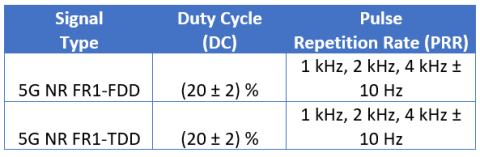
This report characterizes the emissions of 5G wireless communication equipment and identifies a set of immunity test signals developed to represent a range of emissions from 5G NR emitters following 3GPP protocols (see Table 1 below) [1]. These test signals, in combination with a suitable test method can be used to expose a device under test (DUT) to emissions representative of 5G FR1 cellular technology as part of electromagnetic compatibility testing.
Intended Purpose
This RST comprises immunity test signals for testing medical device immunity to proximity fields from 5G FR1 wireless communication equipment. This RST was developed for application to medical devices and accessories that are electrically powered or that contain electrical or electronic circuitry.
Medical device Electromagnetic Compatibility (EMC) may be assessed following available consensus standards, including FDA-recognized standards such as IEC 60601-1-2:2014/AMD1:2020 [2], ISO 14708-1:2014 [3], or ISO 14117:2019 [4], which describe or reference test methods to assess medical device immunity to various types of electromagnetic disturbances with different characteristics such as frequency and modulation. However, these standards do not provide specific test signals to assess immunity to certain emerging emitter technologies, including 5G wireless communication equipment.
Testing
This study developed 5G FR1 immunity test signals based on simulation analysis of 5G NR emissions per 3GPP specifications [1]. To demonstrate the test signals’ utility, testing was performed using a Holter monitor (an example of a wearable device with analog and digital electrical components) as an example DUT. The rationale behind selecting a 20% duty cycle for representing the 5G NR signals is that 20% was a recurring mode in each of the 5G types simulated in the study.
Limitations
The example test method described in this RST is only applicable to 5G FR1, and this RST does not describe a complete test method for 5G FR2. This RST does not establish minimum acceptable performance for a device under test (DUT), nor does it provide immunity test pass/fail criteria.
Supporting Documentation
[1] S. Mosleh, J. B. Coder, J. M. Ladbury, M. O. Al Kalaa, J. L. Silberberg, Y. Ardeshirpour, J. W. Guag, Y. Liu, and S. J. Seidman, "A metrology-driven approach to distilling live wireless signals into immunity test signals," IEEE Access, vol. 13, pp. 28711-28732, 2025, doi: 10.1109/ACCESS.2025.3540754.
[2] IEC 60601-1-2:2014/AMD1:2020, “Amendment 1 - Medical electrical equipment - Part 1-2: General requirements for basic safety and essential performance - Collateral Standard: Electromagnetic disturbances - Requirements and tests”. https://webstore.iec.ch/en/publication/59644
[3] ISO 14708-1:2014, “Implants for surgery — Active implantable medical devices Part 1: General requirements for safety, marking and for information to be provided by the manufacturer”. https://www.iso.org/standard/52804.html
[4] ISO 14117:2019, “Active implantable medical devices — Electromagnetic compatibility — EMC test protocols for implantable cardiac pacemakers, implantable cardioverter defibrillators and cardiac resynchronization devices”, https://www.iso.org/standard/73915.html
Contact
Tool Reference
- RST Reference Number: RST26ES07.01
- Date of Publication: 7/27/2026
- Recommended Citation: U.S. Food and Drug Administration. (2026). Electromagnetic Immunity Test Signals for Proximity Fields from 5G FR1 Wireless Communication Equipment (RST26ES07.01). https://cdrh-rst.fda.gov/electromagnetic-immunity-test-signals-proximity-fields-5g-fr1-wireless-communication-equipment